The Lines That Distinguish Art Music From Other Kinds Are Clearly Delineated True False

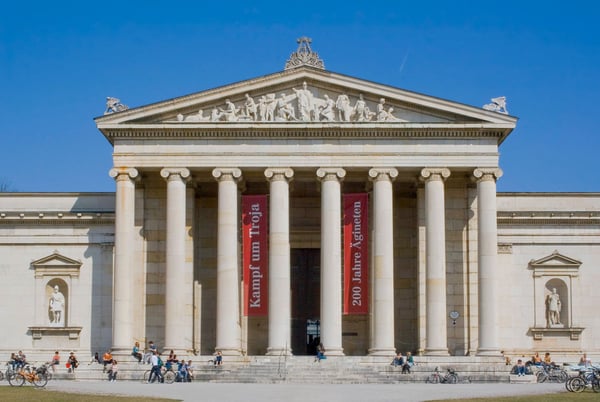
The Classical Catamenia of music may take given its proper noun equally the pop descriptor for all of Western sophisticated instrumental composition, but its actual timeline is relatively short. All of the other delineated musical eras get at least a full century. However, the Classical Era is ofttimes cited equally the latter half of the eighteenth century. At its longest, the Classical Era ran just seventy to eighty years, ending no after than 1820. Despite the Classical Era's curt run, its impact on instrumental music has been enormous. The period takes the appellation "Classical" due to the philosophical and cultural render to the classical values of antiquity, which greatly influenced musical limerick. The Baroque Era ended Europe'southward first return to the philosophical and creative values of classical Rome and Greece. The Classical Era, in turn, was a clear break from the Baroque style. In this article, you'll discover Classical Era music's main characteristics, how it differs from what came before, and how its name has come to be used equally the broader term for Western instrumental music. Most mod music fans would nearly likely find it odd to larn that the music of the Classical Era developed from a search for a simpler, cleaner, more humanistic musical expression with universal qualities and appeal. As office of its reach towards universality, Classical Period composers drew on a combination of qualities, each prevalent in different European traditions. Composers from all over Europe drew on the formality and precision from the Germans, lyrical artistry from Italy, and technical craftsmanship valued in France, to create their works. Ultimately, they adult recognizable forms any audience anywhere could identify and appreciate. Indeed, writing and performing music that would please the greatest number of people was a primary goal of Classical Era composers. They strove to create works with clean, balanced, and elegant audio. For this reason, Classical Era music is largely homophonic with simpler melodies supported by subordinate harmonies and more significant uses of chords. Composers also increased apply of phrases of varying length that are clearly punctuated past cadences. This change in phrasing and increased used of cadences allowed composers to brandish a diverse range of mood and emotional expression within the same piece of work. Haydn'due south Symphony No. fourteen in A major, a representative work of early on Classical Era composition. The Classical Catamenia also saw the formalization of many musical forms, such as the symphony and concerto, that yet form the basis of lilliputian "c" classical music. With this standardization of forms and simpler melodies, the composers of the time included more notations as to how their works were to exist performed. While the era of the virtuoso was yet to come, the private composer started the transition from retainer to the Church building or court to historic artist during the Classical Era. Classical Era music didn't generate itself in a vacuum. Music evolved within the broader culture of the time, chosen the Age of Enlightenment, which shared some characteristics with the Renaissance, most evidently its return to the ancient world of Hellenic republic and Rome for cultural inspiration. Both periods were preceded by times where the Church played a dominant role in society, and the people were sublimated to its volition. In dissimilarity, artifact held to a more than humanistic vision. It provided space for individuality within the context of a universal ideal that connected everyone in common humanity. These universal ideals were expressed through objective truths that could be accessed by all through reason, logic, and dialectic.Newton's writings were highly influential, as they divers a framework and foundation for formal, rational inquiry that could be used to advance scientific discoveries. Information gathered through empirical inquiry could be organized through categorization and bureaucracy, improving the common understanding of the earth. In political philosophy, writers similar Locke and Montesquieu talked well-nigh immutable individual rights that weren't granted past an external authority, like the Church or monarchy, but existed in nature. On an artistic level, values of organization and logic presented themselves through a more orderly aesthetic of residual and elegance. The visual arts of the time are often called "neoclassical" because of their utilise of artifact every bit a creative touchstone. An example of Neoclassical architecture at Glyptothek, Königsplatz, Munich, Germany. Photo by Diego Delso, courtesy of Wikicommons. Sculpture of the era focused on a neoclassical vision of an arcadian, heroic man course. Houdon was famous for his neoclassical busts of gimmicky greats like George Washington and Voltaire. Italian sculptor Canova created full-figure works oftentimes based on ancient mythology similar The Three Graces and his pugilists. These visual artists, as well as the composers of the Classical Era, believed that beauty itself could be achieved through the execution of logical, objective rules, such as proportion and rest. The philosophical revival of reason and the individual, along with a growing, more literate middle grade, began undermining the power and control of the traditional regime. Improvements in printing spread noesis to the public outside the command of the church or monarchies. The people could first making political criticisms of local powers and making their ain leisure choices. In a musical context, this meant that the Church was no longer a primary patron of musicians and composers, nor were noble courts. Aloof houses were of import musical patrons in the Classical Era, but a middle class with growing wealth wanted music in their homes and lives every bit well. Public music festivals and performances also began to grow. The middle class took an interest in condign apprentice musicians and hosts, not just audience members. These social shifts were the other forces that prompted a steady stream of simpler, more than attainable music. For the professional person composers and musicians, the emphasis on science and organization was practical to music by codifying compositional rules, which led to the establishment of many of the classical music forms that are still used at present. Classical values of rationalism, universality, cosmopolitism, and elegance were the artistic inspirations for Classical Era music. These Classical ideals manifested themselves in music using: A great case of a Classical Era device that encapsulates the aesthetic and philosophical values of the day: utilise of the antecedent/consequent melody, which presents a distinct, linear melody underscored by a harmonious balance and a clear resolution marking the role's end. Here'south an example from the commencement movement of Mozart'southward Symphony in C Major, K. 551 Some major artistic shifts occur as evolutions from what came earlier, while others arise from a rejection of the precedent way. Much of what defined Classical Era music tin can exist seen as a rejection of the artful values and hallmarks of the Baroque menstruation. Baroque and Classical music co-existed for a time. Musical tastes moved through diverse transition phases before the Baroque Period truly ended. The Late Baroque Period was dominated past a new creative style called "rococo." Rococo departed from Baroque arts equally a lighter, more playful style. Baroque arts and compages are highly decorated with neat ornamental flourishes. In music, the rococo mode was called the Galant style or sensitive style. More elegant and restrained than Baroque music, simply also less serious. Composers enjoyed the fashionable manner for its more harmonious aspect. Nevertheless the growing sense that the Galant style ornamentation was shallow and only decorative didn't align well with the philosophical, orderly preferences of the Enlightenment. Hence the concluding stronger pause with Baroque artistic values and forms. Yous tin see the Classical Era traits, characterized by its natural, simpler style considered to exist reflecting an objective standard of good sense of taste, in clear relief when compared to Baroque music: The Manheim School, based in German royal court, grew during this period of overlap between Bizarre and Classical and its transitional styles. The Manheim composers, working in the middle eighteenth century, were early adopters and innovators of the Classical music norms that would exist more than fully adult and codified later in the Classical Era. Manheim school composer Carl Stamitz is an fantabulous example of this fourth dimension; his works show some elements of Galant style as well apply of the sonata grade. Stamitz's Viola Concerto No. ane in D Major By the belatedly eighteenth century, came the height of the Classical Era with the Viennese Classical style, sometimes referred to every bit the First Viennese Schoolhouse. Vienna was the creative and cultural epicenter of Europe. All the great and skilful composers convened there, including Mozart, Haydn, and Beethoven. It was during the middle and late phases of the Classical Era that the codified musical forms, such every bit the symphony and sonata course, were settled. This was also the apex of Classical Era music values, as evidenced by Beethoven's String Quartet in F major, Op. 59, No. 1 (1806). Having noble, provincial patrons, rather than a local church building or regal court with nearly unlimited resources, frequently left Classical composers with fewer musicians of varying skill. This relative scarcity aligned nicely with Age of Enlightenment values of simpler, universal music that could be enjoyed and even performed, by middle-class music aficionados. The effect was the growth of bedchamber music during the Classical Era. Examples include: Mozart'southward Eine kleine Nachtmusik KV 525 Haydn's String Quartet Op. 33, No. iii (The Bird) Haydn likewise standardized the symphony format into four movements (although Mozart typically stuck with three): Standardization of the sonata form was a necessary role of the formalizing the four-movement symphony. During this era, the sonata form was codified into its exposition – development – recapitulation design of thematic exploration. Ii other musical forms adult during the Classical Era that replaced the Baroque concerto grosso, a form of smaller groups of instruments performing against a larger orchestra: Joseph Boulogne'southward, Chevalier de Saint Georges, Symphonie concertante in Yard Major Some other popular music format to appear during the Classical Era was the comic opera. Not that serious opera wasn't prevalent during this menstruum. It was and often drew of stories from Greek mythology, like Gluck's Orfeo ed Euridice. Comic opera, or opera buffa, told the stories of everyday people in crazy circumstances or in the epic search for dear – not dissimilar the sitcom way of tv set, but with more music. For instance, at that place's Mozart's Cosi Fan Tutte, where two soldiers make bets whether their girlfriends tin can remain faithful. I of the main departures from the Bizarre Era was the disappearance of the harpsichord from Classical Era composition. The pianoforte replaced it by the eye of the eighteenth century, just it wasn't a key musical instrument in the works as the harpsichord was. However, the appearance of the piano, much as we know information technology today, arrived past the belatedly eighteenth century and classical composers loved it, writing many concertos and sonatas. The strings took on greater prominence, due to their particular ability to best reflect the human vocalisation. That human, natural element was appealing to Classical audiences. Mozart formalized the violin sonata with piano accompaniment during the Classical Era, which generally contained two movements. Mozart's Violin Sonata No. 21 in Due east Minor The woodwinds as well took on a conspicuous function and for the first time, became a distinct section within the orchestra. Like strings, woodwinds were prized for their ability to produce natural, elegant tones. The number and type of woodwind and horn instruments that became standard in an orchestra grew. The entire orchestra grew and was standardized during the Classical Menses. Its basic format of four instrumental sections was set up past composers of the Manheim school. After during the Classical Period, the standard orchestra size grew past adding multiples to existing instruments, especially in the woodwind and horn sections. The inclusion of new instruments, similar the trombone and French horn, too contributed to the larger orchestra. You've gotten a gustation already of the three major figures of the Classical Era: Haydn, Mozart, and Beethoven. As essential as they are to affectionate Classical Era music, there were other talented composers and works worth noting from the time. Check out our list of the 10 Classical Composers Y'all Demand to Know for a deeper similar into a broader assortment of Classical composers. If the musical samples hither aren't enough (and they're not), we've also put together 20 of the Best Classical Catamenia Composition of All Time . How's that for some Classical symmetry and simplicity! The beauty of standardizing forms is that they serve as a fertile starting bespeak for further innovation. Even during the afterwards stages of Classical Period itself, Classical composers were already playing effectually with the very forms they organized. For example, the larger orchestra became a vehicle for intense, grand expression. Thus, with some assist from Beethoven, information technology was a goad in ushering in the Romantic Era. Heed to his Symphony No. 3 in Due east apartment major (Eroica). Indeed, the Historic period of Reason moral philosophies of individualism and freeing individuals from powerful, external authorities provided its ain foundation for the freer, less retrained emotional expressiveness of the Romantic Era. Short description of what ClassicaL Era music is
Origins and context of the Classical Period
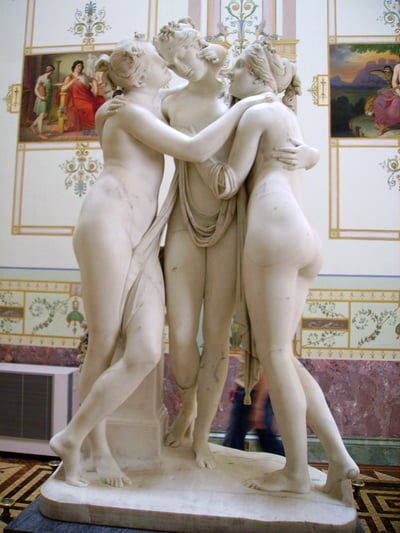 Canova's The Three Graces. Photo by Yair Haklai, courtesy of Wikicommons.
 Hallmarks of Classical Menses Music
How Classical Era music separated itself from Baroque music
Galant or "Sensitive way" music as stepping stone betwixt Baroque and Classical Eras
Clear distinctions betwixt Baroque and Classical Music
From the Manheim School to the Viennese Classical Style
Evolution of musical forms
Evolution of Orchestras and Instruments during the Classical Period
Exploring Classical Era Composers and their Works
Classical Era sets the foundation for more personal exploration of the Romantic Era

hendersonfeeirid96.blogspot.com
Source: https://www.connollymusic.com/stringovation/the-classical-period-of-music
0 Response to "The Lines That Distinguish Art Music From Other Kinds Are Clearly Delineated True False"
Post a Comment