what not to eat if you have takayasu arteritis
Contents
- What is temporal arteritis
- Temporal arteritis / Giant cell arteritis symptoms
- Temporal arteritis causes (behemothic cell arteritis causes)
- Hazard factors for developing temporal arteritis (giant cell arteritis)
- Temporal arteritis (giant cell arteritis) complications
- Temporal arteritis diagnosis (Behemothic jail cell arteritis diagnosis)
- Temporal arteritis / Behemothic prison cell arteritis treatment
-
- About prednisone
- Other treatments
- Dwelling remedies
-
- Takayasu arteritis
- Takayasu's arteritis symptoms
- Stage one Systemic phase Takayasu's arteritis
- Stage 2 Occlusive phase Takayasu's arteritis
- Takayasu'southward arteritis causes
- Risk factors for Takayasu's arteritis
- Takayasu's arteritis complications
- Takayasu's arteritis and Pregnancy
- Takayasu's arteritis diagnosis
- Takayasu's arteritis treatment
- Living with Takayasu'south arteritis
- Takayasu's arteritis symptoms
What is temporal arteritis
Temporal arteritis (giant jail cell arteritis) is where the arteries, specially those at the side of your head (the temples), become inflamed. Temporal arteritis (giant cell arteritis) is a serious status that requires urgent treatment.
- Temporal arteritis (giant jail cell arteritis) tin can atomic number 82 to serious bug like stroke and blindness if not treated speedily.
Giant prison cell arteritis (temporal arteritis) is the most common grade of vasculitis that occurs in adults. Almost all patients who develop temporal arteritis (giant cell arteritis) are over the age of 50. The average age at onset is 72, and almost all people with the disease are over the age of 50. Women are afflicted with temporal arteritis two to 3 times more commonly than men. Temporal arteritis (giant cell arteritis) tin can occur in every racial group but is nigh common in people of Scandinavian descent. Giant cell arteritis (temporal arteritis) commonly causes headaches, joint pain, facial pain, fever, and difficulties with vision, and sometimes permanent visual loss in one or both eyes. Considering the illness is relatively uncommon and because the disease can cause then many different symptoms, the diagnosis of temporal arteritis (giant jail cell arteritis) can be difficult to brand. With advisable therapy, giant cell arteritis (temporal arteritis) is an eminently treatable, controllable, and often curable disease.
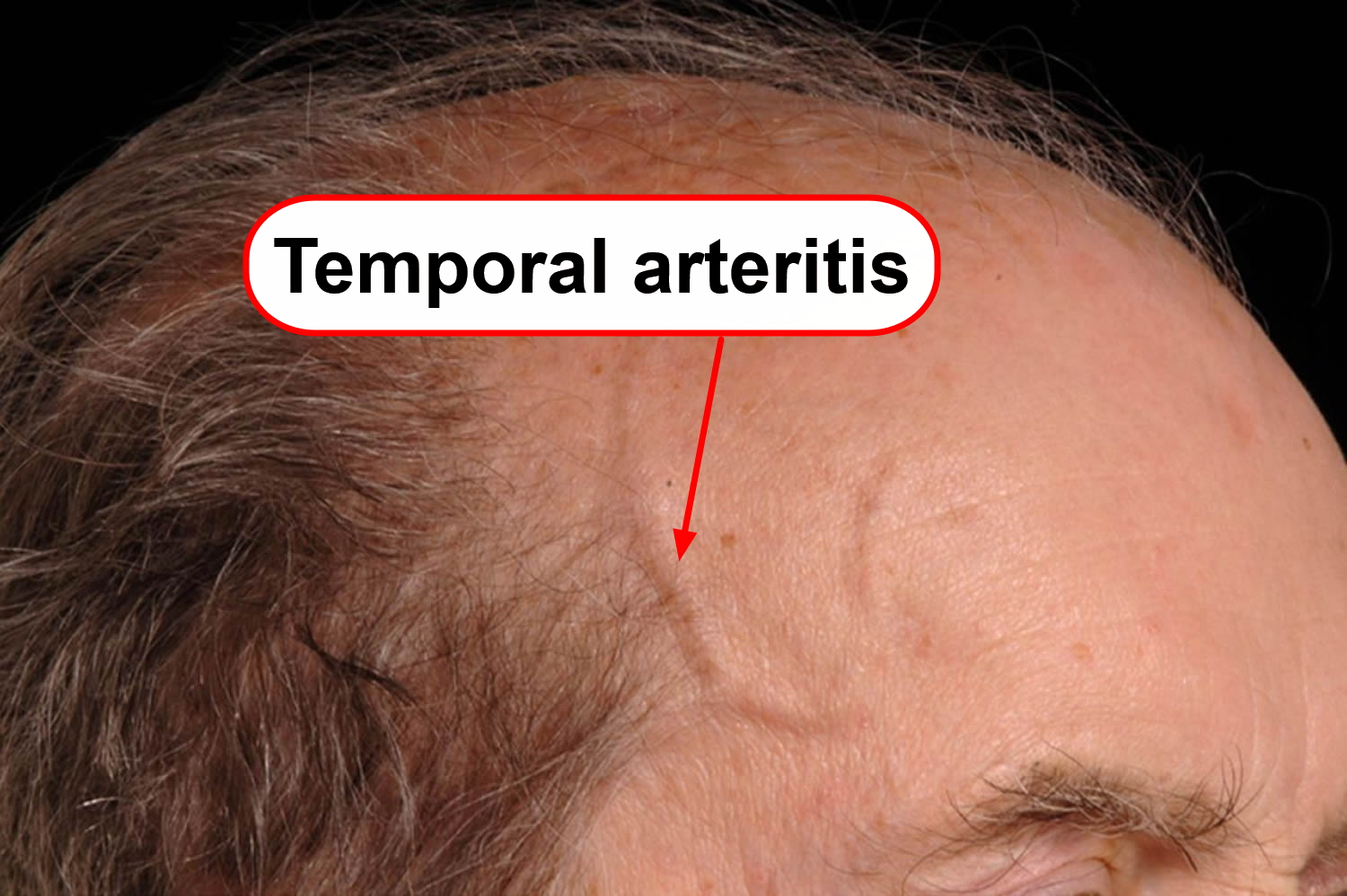
Behemothic prison cell arteritis used to be chosen "temporal arteritis" because the temporal arteries, which course forth the sides of your head just in front of the ears (to the temples) can get inflamed. However, scientists and doctors also know that other blood vessels, namely the aorta and its branches, can too become inflamed. The term "behemothic cell arteritis" is oftentimes used because when yous looks at biopsies of inflamed temporal arteries under a microscope, y'all frequently sees large or "giant" cells.
The diagnosis is made past doing a biopsy of the temporal avenue. Using a local numbing medication (the same i used by a dentist), the doc tin remove a minor part of the temporal artery from nether the scalp and look at it under the microscope for evidence of inflammation. A temporal artery biopsy is almost e'er safe, causes very trivial pain, and frequently leaves little or no scar.
The mainstay of handling is glucocorticoids (corticosteroids); temporal arteritis (giant cell arteritis) is now correspond one of the most common reasons for medium-to-high dose, long-term corticosteroid treatment in main intendance.
Figure 1. Temporal arteritis (giant prison cell arteritis)

Temporal arteritis / Behemothic cell arteritis symptoms
The symptoms of temporal arteritis (giant cell arteritis) depend on which arteries are affected. The onset of temporal arteritis (giant cell arteritis) tin can feel like the flu.
The most common symptoms of temporal arteritis (giant jail cell arteritis) are:
- frequent, severe headaches,
- hurting and tenderness over the temples
- pain in the shoulders and hips (called polymyalgia rheumatica),
- hurting in the jaw while eating or talking (called jaw claudication),
- fever,
- vision problems, such as double vision, blurred vision or a loss of vision in one or both optics
Other symptoms can include tenderness of scalp (it hurts to comb the hair), cough, throat hurting, tongue pain, weight loss, low, stroke, or pain in the arms during practise. Some patients have many of these symptoms; others have simply a few. Blindness — the most feared complexity — can develop if temporal arteritis (behemothic cell arteritis) is non treated in a timely style.
More than general symptoms are also common – for case, flu-like symptoms, unintentional weight loss, low and tiredness.
Effectually half of all people with temporal arteritis too develop polymyalgia rheumatica, which causes hurting, stiffness and inflammation in the muscles effectually the shoulders, neck and hips.
Temporal arteritis causes (giant prison cell arteritis causes)
Just what causes these arteries to become inflamed isn't known. Certain genes and gene variations may increase your susceptibility to the status. Scientists do know that aging has something to practice with the disease. And scientists know that the trunk's immune organization attacks and inflames the arteries. But scientists do non know why the immune organisation attack occurs when and where it does.
With temporal arteritis (giant cell arteritis), the lining of arteries becomes inflamed. This causes them to smashing. This swelling narrows your blood vessels, reducing the amount of blood — and, therefore, oxygen and vital nutrients — that reaches your torso's tissues.
Almost any large or medium-sized artery can exist affected, but swelling most frequently occurs in the arteries located in the temples. These are located just in front of your ears and continue upwards into your scalp. Sometimes the swelling affects just office of an artery with sections of normal vessel in between.
Risk factors for developing temporal arteritis (giant jail cell arteritis)
Several factors can increase your risk of developing behemothic cell arteritis, including:
- Age. Temporal arteritis (giant jail cell arteritis) affects adults only, and rarely those under 50. Most people with this condition first feel warning signs betwixt the ages of seventy and 80.
- Sex activity. Women are about two times more likely to develop the status.
- Race and geographic region. Temporal arteritis (giant cell arteritis) is near common amidst whites in northern European populations or of Scandinavian descent.
- Polymyalgia rheumatica. Having polymyalgia rheumatica puts you at increased risk of developing giant cell arteritis.
- Family unit history. Sometimes the condition runs in families.
Temporal arteritis (giant cell arteritis) complications
Temporal arteritis (behemothic cell arteritis) can crusade the following complications:
- Blindness. Diminished blood flow to your eyes tin cause sudden, painless vision loss in ane or, rarely, both optics. Loss of vision is commonly permanent.
- Aortic aneurysm. An aneurysm is a bulge that forms in a weakened blood vessel, ordinarily in the aorta, the large avenue that runs down the centre of your breast and abdomen. An aortic aneurysm may burst, causing life-threatening internal bleeding. Because this complexity may occur fifty-fifty years after the initial diagnosis of giant cell arteritis, your doctor may monitor the health of your aorta with annual breast X-rays or other imaging tests, such every bit ultrasound and CT.
- Stroke. This is an uncommon complication of temporal arteritis (giant cell arteritis).
Temporal arteritis diagnosis (Giant prison cell arteritis diagnosis)
Temporal arteritis (giant cell arteritis) tin can be hard to diagnose because its early symptoms resemble those of many mutual conditions. For this reason, your medico will try to rule out other possible causes of your problem.
To help diagnose temporal arteritis (behemothic cell arteritis), you may have some or all of the post-obit tests and procedures:
- Physical exam. In addition to asking about your symptoms and medical history, your dr. is likely to perform a thorough physical exam, paying item attention to your temporal arteries. Often, one or both of these arteries are tender with a reduced pulse and a difficult, cord-like feel and appearance.
- Blood tests. If your doctor thinks you might have temporal arteritis (giant prison cell arteritis), you're likely to have a claret exam that checks your erythrocyte sedimentation rate — unremarkably referred to equally the sed charge per unit. This test measures how rapidly red blood cells fall to the bottom of a tube of blood. Ruby-red cells that drib apace may indicate inflammation in your body. Yous may also take a test that measures C-reactive protein (CRP), a substance your liver produces when inflammation is nowadays. The same tests may be used to follow your progress during treatment.
- Temporal arteritis biopsy. The best style to confirm a diagnosis of temporal arteritis (giant cell arteritis) is by taking a pocket-size sample (biopsy) of the temporal artery. The procedure is performed on an outpatient ground during local anesthesia, usually with little discomfort or scarring. The sample is examined under a microscope in a laboratory. If y'all have temporal arteritis (giant prison cell arteritis), the artery volition often show inflammation that includes abnormally big cells, called giant cells, which give the disease its name. It'southward possible to have temporal arteritis (giant prison cell arteritis) and still accept a negative biopsy result. If the results aren't clear, your dr. may advise some other temporal artery biopsy on the other side of your head.
Imaging tests may be used for diagnosing giant cell arteritis and for monitoring your response to treatment. Possible tests include:
- Magnetic resonance angiography (MRA). This test combines the utilize of magnetic resonance imaging (MRI) with the apply of a contrast material that produces detailed images of your claret vessels. Allow your doctor know ahead of fourth dimension if you're uncomfortable beingness bars in a small-scale infinite because the examination is conducted in a tube-shaped machine.
- Doppler ultrasound. This test uses sound waves to produce images of blood flowing through your blood vessels.
- Positron emission tomography (PET). Using an intravenous tracer solution that contains a tiny amount of radioactive textile, a PET browse tin can produce detailed images of your blood vessels and highlight areas of inflammation.
Temporal arteritis / Giant cell arteritis treatment
Treatment for temporal arteritis (behemothic prison cell arteritis) consists of high doses of a corticosteroid drug such as prednisone. Typically, handling begins with forty–sixty mg of prednisone, taken past mouth each twenty-four hour period. Almost patients improve rapidly and dramatically on this dose, with comeback of most symptoms in 1–iii days. Unfortunately, if blindness has occurred as a symptom it is usually irreversible, which just emphasizes the importance of early detection and treatment.
Treatment will be started earlier temporal arteritis (giant cell arteritis) is confirmed because of the risk of vision loss if information technology isn't dealt with quickly.
You'll likely begin to feel better within just a few days of beginning treatment. Unless you have complete vision loss, your visual symptoms will probable clear up within three months.
Y'all may demand to continue taking medication for one to ii years or longer. After the first month, your physician may gradually begin to lower the dosage until you reach the lowest dose of corticosteroids needed to control inflammation.
Some symptoms, particularly headache, may return during this tapering catamenia. This is too the point at which many people also develop symptoms of polymyalgia rheumatica. Such flares tin usually exist treated with slight increases in the corticosteroid dose. Your doctor may also propose a drug called methotrexate, which may assist reduce the side effects of corticosteroids.
Corticosteroids can atomic number 82 to a number of serious side effects, such as osteoporosis, loftier blood pressure and musculus weakness. To counter these potential side effects, your doctor is probable to monitor your os density and may prescribe calcium and vitamin D supplements or other medications to assistance prevent bone loss. Your dr. is too likely to monitor your claret pressure and may recommend an practice program, nutrition changes and medication to keep blood pressure inside a normal range. Almost side furnishings go away when the corticosteroid treatment is tapered and stopped.
There are 2 stages of treatment:
- An initial loftier dose of steroids for a few weeks to help bring your symptoms under command.
- A lower steroid dose (later your symptoms take improved) given over a longer period of fourth dimension, possibly several years.
You'll have regular follow-ups to see how you're doing and check for whatever side furnishings you may accept. Almost all patients experience side furnishings from prednisone. After the patient improves, the medico gradually reduces the prednisone dose. The rate of tapering prednisone depends on how the patient feels, what the doctor finds on exam, and the results of blood tests, including the sedimentation rate. Although virtually all patients are able to reduce their prednisone dose, most crave some amount of prednisone for 1–2 years. Longer treatment periods are not uncommon. A small-scale number of people may need to accept steroids for the rest of their life.
About prednisone
Prednisone is a blazon of medicine known equally a corticosteroid or steroid. Corticosteroids are Not the same equally anabolic steroids.
Prednisone is used to treat a broad range of health problems including allergies, blood disorders, skin diseases, infections, certain cancers and to prevent organ rejection after a transplant.
It helps by reducing inflammation. It too damps down your allowed system, which can help in autoimmune illnesses, like temporal arteritis (giant cell arteritis) and rheumatoid arthritis, where your immune system mistakenly attacks its own tissues.
Prednisolone is bachelor merely on prescription as tablets and as a liquid to drinkable. It can also be given past injection just this is usually only done in hospital.
- It'southward important to have prednisolone as your doctor has advised.
- Accept prednisolone once a day in the morn so it doesn't continue you awake.
- Taking prednisolone can make you more likely to get infections. Tell your doctor if you're exposed to infectious illnesses like chickenpox or shingles.
- The most common side effects of prednisolone are weight gain, indigestion, insomnia and sweating a lot.
- Prednisolone can cause withdrawal problems if you end taking information technology suddenly. Do not stop the medicine all of a sudden if you've been on it for more than 3 weeks or have taken high doses (more 40mg) for more than 1 week.
Side effects
The college the dose of prednisolone that you take, the greater the chance of side effects. You are less likely to become side furnishings if you take a relatively low dose of less than 20mg prednisolone daily.
Some side furnishings, such as stomach upset or mood changes, tin can happen straight away. Others, such as getting a rounder face, happen subsequently weeks or months.
Common side effects
Mutual side furnishings happen in more than ane in 100 people. Proceed taking the medicine, but tell your doctor if they bother y'all or don't go away:
- weight gain
- indigestion
- not able to slumber
- restlessness
- sweating a lot
Serious side effects
You are more likely to have a serious side effect if yous accept a higher dose (more than 20mg daily) of prednisolone or if y'all have been taking it for more a few weeks.
Tell a doctor straight abroad if yous become:
- fever, chills, a very sore throat, ear or sinus pain, a coughing, more than saliva or a modify in colour of saliva, pain with passing urine, rima oris sores or a wound that will not heal – these can be signs of an infection
- sleepy or dislocated, feeling very thirsty or hungry, passing urine more than frequently, flushing, breathing quickly or breath that smells like fruit – these can be signs of loftier blood saccharide
- weight proceeds in the upper back or belly, moon face up, very bad headaches and irksome wound healing – these can exist signs of Cushing's syndrome
- a very upset stomach or vomiting, very bad dizziness or passing out, muscle weakness, feeling very tired, mood changes, loss of appetite and weight loss – these tin can be signs of adrenal gland issues
- muscle pain or weakness, muscle cramps, or a heartbeat that does not feel normal – these can be signs of depression potassium levels
- severe stomach pain, severe back hurting, severe upset tum or vomiting – these can be signs of pancreas bug
You should also tell a doctor directly away if you get:
- incoherent
- swelling in your arms or legs
- changes in your eyesight
- any bruising or haemorrhage that isn't normal
- black poo
- black or dark brown vomit or vomiting blood
Serious allergic reaction
In rare cases, it'due south possible to have a serious allergic reaction to prednisolone.
Other treatments
Other types of medication you may demand if you lot have temporal arteritis (giant cell arteritis) include:
- low-dose aspirin – to reduce the adventure of stroke or a center assail, which can occur if the arteries to your eye are affected
- proton pump inhibitors (PPIs) – to lower your take a chance of getting a stomach problem like indigestion or a tum ulcer, which can exist a side effect of taking prednisolone
- bisphosphonate therapy – to reduce the adventure of osteoporosis when taking prednisolone
- immunosuppressants – to permit steroid medication to exist reduced and assistance prevent temporal arteritis coming back
Habitation remedies
When temporal arteritis (behemothic cell arteritis) is diagnosed and treated early, the prognosis is usually splendid. Your symptoms will likely better quickly after beginning corticosteroid treatment, and your vision isn't likely to be affected. Your greatest claiming in this case may be coping with any side effects of your medication.
The following suggestions may assistance:
- Eat a healthy diet. Eating well can help forestall potential problems, such as thinning bones, loftier blood pressure and diabetes. Emphasize fresh fruits and vegetables, whole grains, and lean meats and fish, while limiting salt, saccharide and alcohol. Be sure to become adequate amounts of calcium and vitamin D. Experts recommend ane,200 milligrams of calcium and 800 international units (IU) of vitamin D a 24-hour interval for women over 50 and men over seventy. Check with your doc to see what dose is right for you.
- Practice regularly. Regular aerobic exercise, such as walking, tin can help forbid bone loss, high blood pressure level and diabetes. Information technology also benefits your heart and lungs. In addition, many people find that exercise improves their mood and overall sense of well-beingness. If you're not used to exercising, start out slowly and build up gradually. Your doc tin help you lot program an exercise programme that's right for you.
- Go regular checkups. See your physician to check for side effects of treatment and development of any complications.
- Inquire nearly aspirin. Ask your doctor about taking between 75 and 150 milligrams of aspirin daily. Taken daily, low-dose aspirin may reduce the risk of blindness and stroke.
Coping and support
Learning everything you tin can well-nigh temporal arteritis (giant prison cell arteritis) and its treatment can help you feel more in control of your condition. Your health intendance squad tin can reply your questions, and online support groups may also be of help. Know the possible side effects of any medication yous take, and report any changes in your health to your doctor.
Takayasu arteritis
Takayasu's arteritis is a rare blazon of vasculitis, a group of disorders that cause blood vessel inflammation. In Takayasu'south arteritis, the inflammation damages the aorta — the large artery that carries claret from your center to the rest of your body and its main branches. Takayasu'due south arteritis is occasionally called "pulseless disease", considering of the difficulty in detecting peripheral pulses that sometimes occurs as a result of the vascular narrowings.
The commencement case of Takayasu'south arteritis was described in 1908 by Dr. Mikito Takayasu at the Almanac Coming together of the Nippon Ophthalmology Society. Dr. Takayasu described a peculiar "wreathlike" appearance of blood vessels in the back of the eye (retina). It is at present known that the blood vessel malformations that occur in the retina are a response (new blood vessel growth) to arterial narrowings in the neck, and that the absence of pulses noted in some patients occur considering of narrowings of blood vessels to the artillery.
Takayasu'south arteritis tin atomic number 82 to blockages or narrowed arteries (stenosis) or abnormally dilated arteries (aneurysms). Takayasu's arteritis can also lead to arm or breast pain and high blood pressure and eventually to heart failure or stroke.
The "typical" patient with Takayasu's arteritis is a woman under the historic period of 40. In that location is a ix:1 female predominance in this disease. Although the illness has a worldwide distribution, information technology appears to occur more often in Asian women.
Takayasu's arteritis is a rare disease. The best estimates of the disease frequency suggest that 2 or 3 cases occur each yr per million people in a population.
If you don't have symptoms, you may not need treatment. Or you may demand medications to control the inflammation in the arteries and prevent complications. But even with treatment, relapses are common.
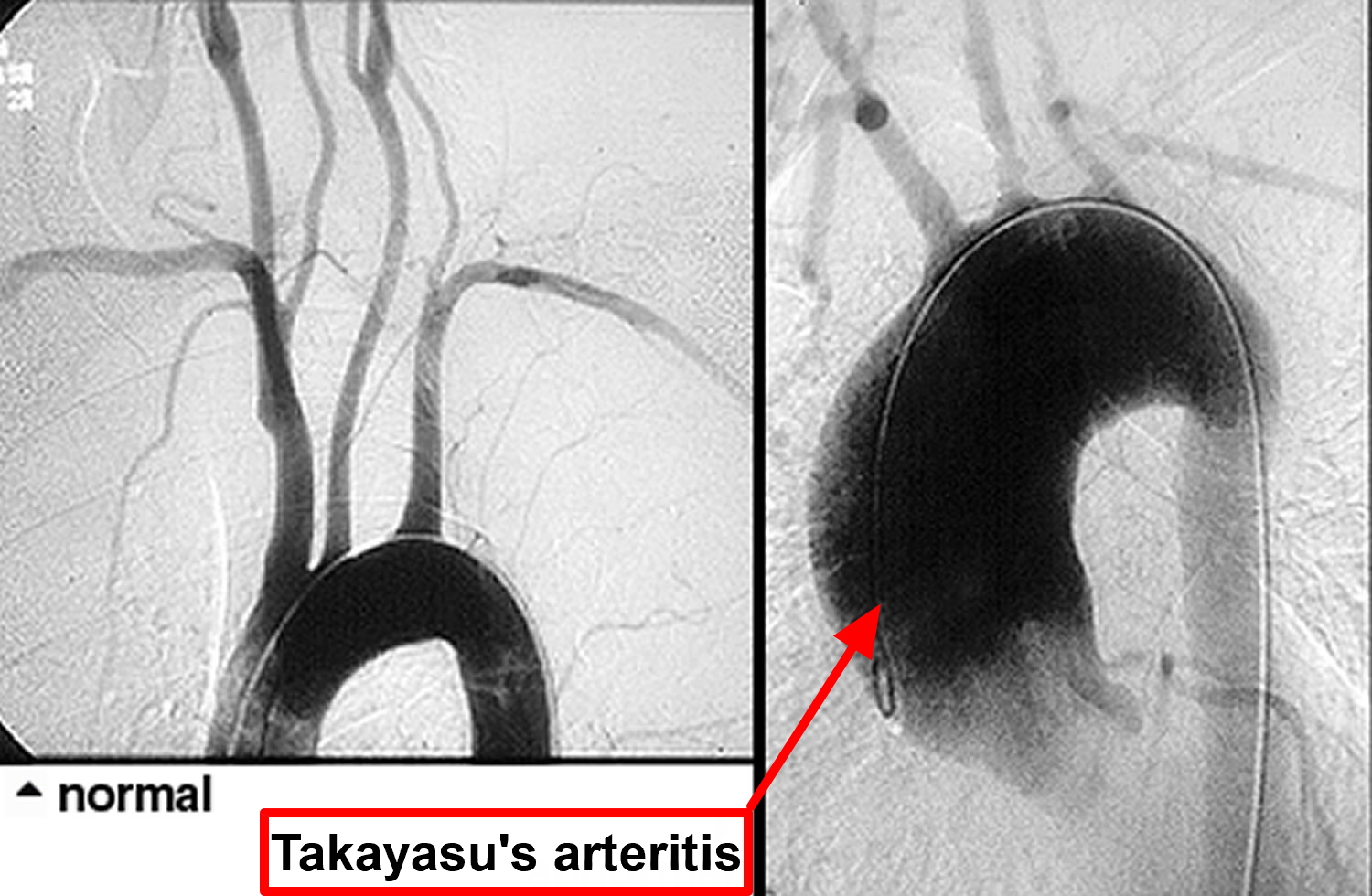
Figure two. Takayasu's arteritis
Takayasu's arteritis symptoms
Takayasu'southward arteritis is a chronic inflammatory status that affects the largest blood vessel in the body (the aorta) and its branches. Thus, the complications of Takayasu's arise directly or indirectly from harm to these blood vessels. The vasculitides are classified according to the size of blood vessel involved. Takayasu's is the classic "large vessel" vasculitis.
Clinicians dissever Takayasu's arteritis into 2 phases: 1) a systemic phase; and 2) an occlusive phase. Although these 2 phases are not always distinct (i.e., patients may have features of both phases at the same time), this division is a useful manner of thinking about the disease.
Stage 1 Systemic phase Takayasu'due south arteritis
In the systemic phase, patients have symptoms and signs of an agile inflammatory affliction. These may include "constitutional symptoms" (fever, fatigue, weight loss), arthritis, and non-specific aches and pains. There may exist tenderness overlying affected arteries. Most patients have elevations of the erythrocyte sedimentation charge per unit during the systemic phase.
The systemic stage is succeeded by the occlusive stage, during which patients brainstorm to develop symptoms caused by the narrowing of affected arteries.
In the first stage, you're likely to feel unwell with:
- Fatigue
- Unintended weight loss
- Full general aches and pains
- Mild fever
Non everyone has these early on signs and symptoms. It's possible for inflammation to harm arteries for years before y'all realize something is wrong.
Stage ii Occlusive phase Takayasu'due south arteritis
During the 2nd stage, inflammation is causing arteries to narrow so less blood, oxygen and nutrients achieve your organs and tissues. Stage 2 signs and symptoms may include:
- Weakness or pain in your limbs with use
- Lightheadedness, dizziness or fainting
- Headaches
- Memory problems
- Problem thinking
- Shortness of breath
- Visual changes
- Loftier blood pressure
- Deviation in blood pressure level between your arms
- Decreased pulse
- Too few reddish claret cells (anemia)
- Breast pain
- Noises heard over the arteries (bruits) when listening with a stethoscope
The narrowing of affected arteries may cause pain in your limbs that occurs during repetitive activities ("claudication"), such as pain in the arm that occurs while using a handsaw or hurting in the calves brought on by walking. The symptoms also include dizziness upon standing upwards, headaches, and visual problems. During the occlusive phase, affected claret vessels may be narrowed to such an extent that the normal arterial pulsations ("pulses") in the cervix, elbow, wrist, or lower extremities cannot exist felt. Using a stethoscope, one may also hear "bruits", a harsh, "whooshing" sounds made by the flow of claret through abnormally narrowed vessels. High claret pressure is common, merely blood pressures taken in the artillery may be read as falsely low if at that place is a narrowing of an artery high up in the arm. With some patients, it is not possible to get accurate blood pressure readings in the arms. Using an ophthalmoscope, a physician may notice characteristic malformations of blood vessels that occur in advanced cases of Takayasu'due south arteritis.
Although the lung involvement in Takayasu'southward is often overshadowed by involvement of systemic large claret vessels, the pulmonary arteries may also be affected in this disorder.
Takayasu's arteritis causes
No i knows exactly what causes the initial inflammation in Takayasu'southward arteritis. Some evidence suggests that an infection of some kind — viral, bacterial, or other — occurring in a person with other predisposing factors (such as the correct genes), may lead to this disease. This is an bonny hypothesis, merely definitive evidence for it is defective. It'south probable that the status is an autoimmune disease in which your immune system attacks your own arteries by mistake. The illness may be triggered by a virus or other infection.
With Takayasu's arteritis, the aorta and other major arteries, including those leading to your head and kidneys, become inflamed. Over time the inflammation causes changes in these arteries, including thickening, narrowing and scarring.
Take chances factors for Takayasu's arteritis
Takayasu'southward arteritis primarily affects girls and women betwixt the ages of 10 and xl. The disorder occurs worldwide, but it'south most common in Asia. Sometimes the condition runs in families.
Takayasu's arteritis complications
With Takayasu's arteritis, extended or recurring cycles of inflammation and healing in the arteries might lead to one or more of the following complications:
- Hardening and narrowing of blood vessels, which can cause reduced claret flow to organs and tissues
- High blood force per unit area, normally as a effect of decreased blood period to your kidneys
- Inflammation of the center, which may touch on the heart muscle (myocarditis) or the heart valves
- Center failure due to high blood pressure level, myocarditis or aortic regurgitation — a status in which a faulty aortic valve allows blood to leak dorsum into your heart — or a combination of these
- Stroke, which occurs as a issue of reduced or blocked blood menses in arteries leading to your brain
- Transient ischemic attack (TIA), is like a stroke, producing like symptoms but causing no permanent harm
- Aneurysm in the aorta, which occurs when the walls of the blood vessel weaken and stretch out, forming a bulge that has the potential to rupture
- Heart attack, which may occur as a result of reduced claret flow to the heart
Takayasu's arteritis and Pregnancy
A good for you pregnancy is possible for women with Takayasu's arteritis. But the disease and drugs used to treat it can affect your fertility and pregnancy. If you have Takayasu's arteritis and are planning on condign pregnant, work with your md to develop a plan to limit complications of pregnancy before y'all conceive. And during your pregnancy meet your doctor regularly for checkups.
Takayasu's arteritis diagnosis
Making the diagnosis of Takayasu's arteritis tin can be extremely hard. Unfortunately information technology is very common for the disease to smoulder in the walls of big claret vessels for years, causing only non-specific symptoms associated with the systemic stage of the illness (or no symptoms), until a major complication results. These major complications may include dilation of the aorta with "stretching" of the aortic valve in the heart; critically reduced claret menstruum to an arm or leg; a stroke caused by high blood pressure in vessels of the encephalon, and many others.
Your doctor will ask you about your signs and symptoms, acquit a physical exam, and take your medical history. He or she may also have you lot undergo some of the post-obit tests and procedures to help dominion out other conditions that resemble Takayasu's arteritis and to confirm the diagnosis. Some of these tests may too be used to check on your progress during treatment.
- Claret tests. These tests tin exist used to wait for signs of inflammation, such as a loftier level of C-reactive poly peptide or a high erythrocyte sedimentation rate — commonly referred to as a sed rate. Your doctor may also bank check for anemia.
- X-rays of your blood vessels (angiography). During an angiogram, a flexible catheter is inserted into a large artery or vein. A special dye (dissimilarity medium) is then injected into the catheter, and X-rays are taken every bit the dye fills your arteries or veins. The resulting images allow your dr. to come across if blood is flowing normally or if information technology's existence slowed or interrupted due to narrowing (stenosis) of a blood vessel. A person with Takayasu'south arteritis generally has several areas of stenosis.
- Magnetic resonance angiography (MRA). This less invasive class of angiography produces detailed images of your blood vessels without the utilise of catheters or X-rays, although an intravenous contrast medium generally is used. MRA works past using radio waves in a stiff magnetic field to produce data that a computer turns into detailed images of tissue slices.
- Computerized tomography (CT) angiography. This is another noninvasive course of angiography combining computerized assay of 10-ray images with the use of intravenous dissimilarity dye to allow your doctor to check the structure of your aorta and its nearby branches and to monitor blood menstruum.
- Ultrasonography. Doppler ultrasound, a more sophisticated version of the mutual ultrasound, has the power to produce very loftier-resolution images of the walls of sure arteries, such as those in the neck (carotid arteries) and those in the shoulder (subclavian arteries). It may exist able to detect subtle changes in these arteries before other imaging techniques tin.
- Positron emission tomography (PET). This imaging is able to measure the intensity of inflammation in blood vessels. Earlier the scan, y'all are given a radioactive drug (tracer).
Unlike other types of vasculitis, Takayasu's arteritis is not usually diagnosed by the removal and analysis of tissue (biopsy).
In one case the diagnosis is suspected, information technology is usually confirmed by a radiographic process such every bit an angiogram or a magnetic resonance imaging study demonstrating pregnant large artery affliction consequent with Takayasu'southward arteritis. In some cases in which claret vessel damage is then severe as to necessitate surgery to repair the aortic valve, the aorta, or another big blood vessel, physicians are able to brand unequivocal diagnoses by looking at tissue from the involved blood vessels under the microscope. Takayasu'south arteritis is pathologically duplicate from giant prison cell arteritis/temporal arteritis. In both, destruction of the claret vessel wall and giant cells are ofttimes present.
Takayasu's arteritis treatment
Handling of Takayasu'south arteritis focuses on controlling the inflammation with medications and preventing farther damage to your blood vessels. The disease tin can sometimes be difficult to treat because even if you appear to be in remission the affliction might all the same be agile. In add-on, by the time some people are diagnosed, information technology's possible that irreversible damage has already occurred.
On the other hand, if you don't have a lot of signs and symptoms or serious complications, yous may not need treatment at all.
One of the biggest issues confronting Takayasu's patients and the physicians who care for them is determining how active the disease is. This tin can be an exceptionally challenging problem. The erythrocyte sedimentation rate (ESR) probably remains the most reliable marker of illness activity, merely even this test is not helpful in a sizeable number of patients who take active arterial inflammation but normal ESRs. Because the treatments for Takayasu'south arteritis may be associated with substantial side–furnishings, scientists and doctors need more accurate ways of gauging Takayasu'south arteritis disease activeness.
Medications
Talk with your medico about the drug or drug combinations that are options for yous and what the possible side effects are. Your doctor may prescribe:
- Corticosteroids to control inflammation. The first line of treatment is usually with a corticosteroid, such as prednisone. The swell majority of patients with Takayasu's arteritis answer to prednisone. The usual starting dose is approximately one milligram per kilogram of body weight per day (for most people, this is approximately 60 milligrams a day). Because of the pregnant side–effects of long-term high–dose prednisone use, the starting dose is tapered over several weeks to a dose that the dr. feels is tolerable for the patient. Even if you soon offset feeling ameliorate, y'all may need to go along taking the drug long term. Later on the starting time month, your doc may gradually begin to lower the dose until y'all reach the lowest dose you need to control inflammation. Some of your symptoms may return during this tapering flow. Possible side furnishings of corticosteroids include weight gain, increased risk of infections, os thinning (osteoporosis) and menstrual irregularities.
For long–term treatment in addition to prednisone (as "steroid sparing agents"), methotrexate, azathioprine, and even cyclophosphamide are sometimes used. There have been few studies of the apply of these medications in this affliction.
- Other drugs that suppress the immune system. If your condition doesn't answer well to corticosteroids or you take problem tapering off the medication, your doctor may prescribe immunosuppressant drugs. Examples are methotrexate (Trexall) and azathioprine (Azasan, Imuran). Some people reply well to medications that were adult for people receiving organ transplants. These drugs, including mycophenolate mofetil (CellCept), work past suppressing the allowed arrangement, and there is some prove that they may be helpful with corticosteroids in finer reducing blood vessel inflammation in people with Takayasu'south arteritis. The well-nigh common side consequence is an increased adventure of infection.
- Medications to regulate the immune system. If you don't respond to standard treatments, your doctor may suggest drugs that correct abnormalities in the immune system (biologics). Examples are etanercept (Enbrel) and infliximab (Remicade). Minor studies have plant these medications effective at controlling signs and symptoms, too as at reducing the need for corticosteroid treatments. In addition, tocilizumab (Actemra) has been reported to be benign in treating Takayasu'due south arteritis. More research is needed. The most common side effect with these drugs an increased adventure of infection.
Surgery
If your arteries become severely narrowed or blocked, you lot may demand surgery to open or bypass these arteries to allow an uninterrupted flow of blood. Often this helps to amend certain symptoms, such as high blood force per unit area and chest pain. In some cases, though, narrowing or blockage may recur, requiring a second process. Too, if you develop big aneurysms, surgery may be needed to prevent them from rupturing. Your doctor may suggest holding off surgery until your status is in remission.
Surgical options, which are all-time performed when inflammation of the arteries has been reduced, include:
- Featherbed surgery. In this procedure, an artery or a vein is removed from a different office of your body and attached to the blocked artery, providing a bypass for claret to flow through.
- Blood vessel widening (percutaneous angioplasty). During this procedure, a tiny airship is threaded through a claret vessel and into the affected avenue. Once in identify, the balloon is expanded to widen the blocked surface area, and so it'due south deflated and removed.
- Aortic valve surgery. Surgical repair or replacement of the aortic valve may be needed if the valve is leaking significantly (aortic valve regurgitation).
Living with Takayasu'due south arteritis
One of the greatest challenges of living with Takayasu's arteritis may be coping with side furnishings of your medication. The post-obit suggestions may help:
- Understand your condition. Learn everything yous tin can near Takayasu's arteritis and its handling. Know the possible side effects of the drugs you accept, and tell your doctor about any changes in your wellness. Inquire your doctor about the benefit of taking low-dose aspirin regularly.
- Eat a healthy diet. Eating well tin can assistance prevent potential problems that tin result from your condition and medications, such equally high claret pressure, thinning bones and diabetes. Emphasize fresh fruits and vegetables, whole grains, and lean meats and fish, while limiting salt, carbohydrate and alcohol. If you're taking a corticosteroid drug, ask your doctor if you demand to take a vitamin D or calcium supplement.
- Exercise regularly. Regular aerobic do, such as walking, can help prevent bone loss, high blood force per unit area and diabetes. Information technology likewise benefits your centre and lungs. In improver, many people detect that exercise improves their mood and overall sense of well-being.
- Avert all tobacco products. It'southward important to finish using all forms of tobacco to reduce the adventure of injuring your blood vessels and tissues even more.
hendersonfeeirid96.blogspot.com
Source: https://healthjade.net/arteritis/
0 Response to "what not to eat if you have takayasu arteritis"
Post a Comment